
Our Heroes
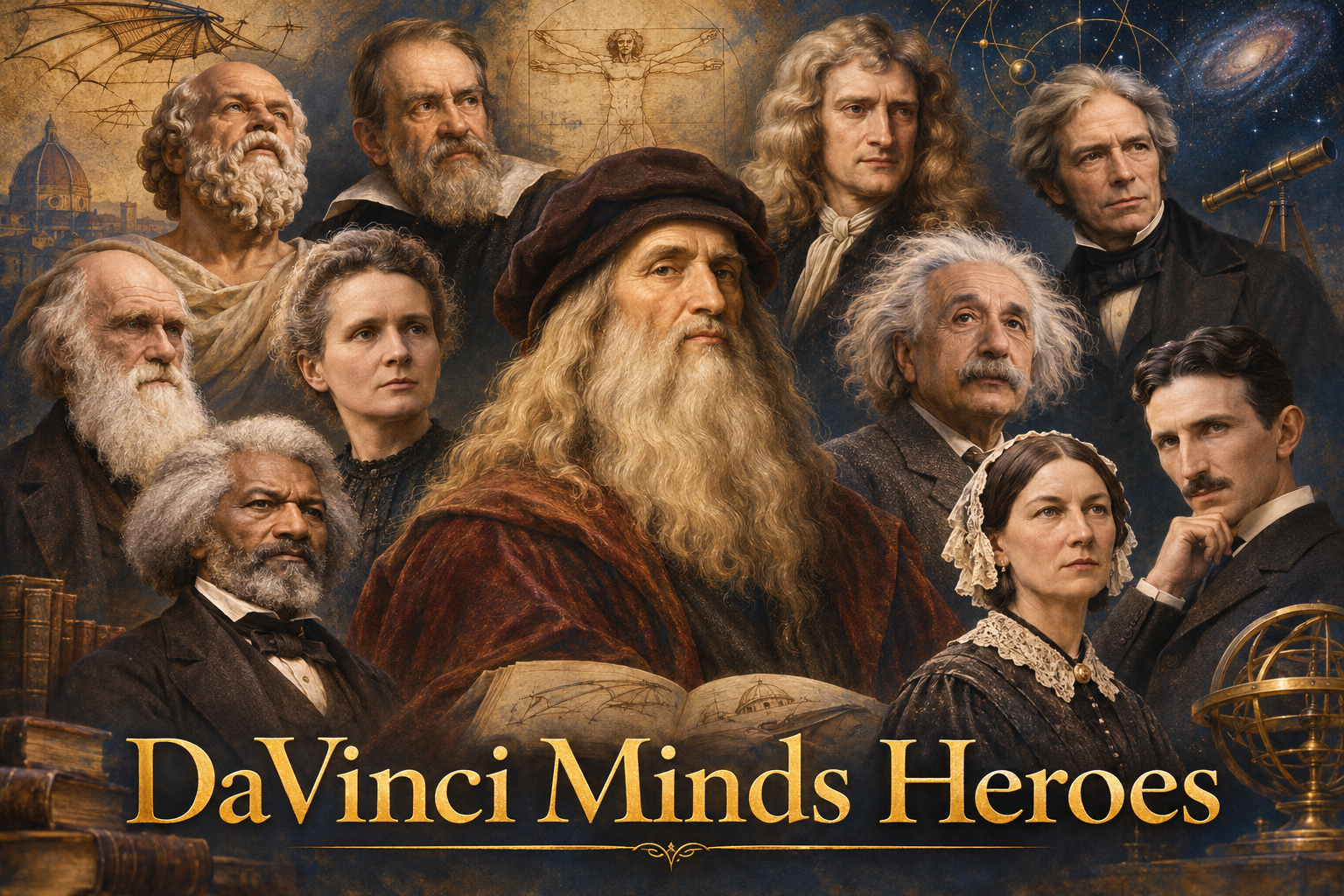
OUR DAVINCI MINDS HEROES
The courage to pursue the Something More
Our DaVinci Minds Heroes questioned, explored, created, and persevered. They saw beyond what their time accepted and pursued possibilities that could advance human understanding and civilization.
Their paths were different. Some revealed patterns in nature. Others opened new possibilities in art, invention, freedom, or the care of others. Their example invites us to look beyond our immediate concerns toward the lives and possibilities of humanity as a whole.
The courage to serve a human future that others could not yet see.
We recognize that courage without needing to regard any life as perfect. Their achievements invite us to ask what we can learn, what we might become, and how we can contribute.
THE PEOPLE IN THE IMAGE
Meet our Heroes
Select a name to read about their life, contribution, and place in the image.
01Leonardo da Vinci 1452–1519
In the image Center foreground, wearing a dark cap, with a long flowing beard.
An Italian Renaissance artist, investigator, and inventor, Leonardo joined close observation with extraordinary imagination. His paintings include the Mona Lisa and The Last Supper, while his notebooks explore anatomy, water, flight, mechanics, and the natural world. He anchors this composite because his curiosity crossed the boundaries between disciplines, expressing a sustained quest to understand and create.
02Socrates c 470–399 BCE
In the image Upper left, bald with a curly white beard and ancient Greek robes.
An Athenian philosopher, Socrates made questioning a way of examining knowledge, virtue, and how people should live. Known chiefly through the writings of others, he challenged confident claims and encouraged deeper self examination. Convicted in Athens and sentenced to death, he represents the courage to question accepted beliefs and remain committed to inquiry under severe pressure.
03Galileo Galilei 1564–1642
In the image Upper row, left of Leonardo, with a gray beard and white collar.
An Italian astronomer, physicist, and mathematician, Galileo used telescopic observations to reveal features of the Moon, moons orbiting Jupiter, and the phases of Venus. His work strengthened the case for a Sun centered planetary system and brought him into conflict with Church authorities. He represents the determination to test inherited explanations against observation and evidence.
04Isaac Newton 1643–1727
In the image Upper row, right of Leonardo, with long curled hair and a white neckcloth.
An English mathematician and natural philosopher, Newton formulated laws of motion and universal gravitation, made major advances in optics, and developed calculus independently of Leibniz. His work connected falling objects on Earth with the motions of celestial bodies. He represents the search for underlying principles capable of bringing seemingly separate phenomena into a larger understanding.
05Michael Faraday 1791–1867
In the image Upper right, above Einstein, clean shaven with swept gray hair.
An English experimental scientist, Faraday discovered electromagnetic induction and made foundational contributions to electrochemistry and the understanding of electric and magnetic fields. Coming from modest circumstances and with limited formal schooling, he developed his abilities through reading, practical work, and experiment. He represents curiosity, disciplined investigation, and the capacity to open new possibilities through persistent learning.
06Charles Darwin 1809–1882
In the image Left middle, beneath Socrates, with a bald head and long white beard.
An English naturalist, Darwin developed the theory of evolution by natural selection, drawing on extensive observation and evidence. His work transformed the study of living organisms and their relationships over time. He represents the patience to assemble a far reaching explanation and the intellectual courage to pursue conclusions that challenge deeply established views of life.
07Marie Curie 1867–1934
In the image Left of Leonardo, between Darwin and the central portrait, in a dark dress.
A Polish born physicist and chemist who worked in France, Curie pioneered research on radioactivity and, with Pierre Curie, discovered polonium and radium. She became the first woman awarded a Nobel Prize and received Nobel Prizes in both physics and chemistry. She represents sustained inquiry, dedication to discovery, and perseverance through substantial barriers to women in science.
08Albert Einstein 1879–1955
In the image Right middle, beside Leonardo, with unruly white hair and a mustache.
A German born theoretical physicist, Einstein developed special and general relativity, reshaping ideas about space, time, motion, and gravity. His explanation of the photoelectric effect also contributed to quantum physics and earned his Nobel Prize. He represents the imaginative power of questioning basic assumptions and following a difficult idea toward a new understanding of reality.
09Frederick Douglass c 1818–1895
In the image Lower left foreground, with swept gray hair and a dark formal coat.
An American abolitionist, writer, orator, and statesman, Douglass escaped enslavement and became a powerful advocate for emancipation, equal citizenship, and women’s rights. His autobiographies and public work exposed slavery’s brutality and challenged the nation to honor its professed ideals. He represents courage directed toward human freedom and a concern for dignity extending beyond one’s own circumstances.
10Florence Nightingale 1820–1910
In the image Lower right foreground, wearing a white lace cap and dark Victorian dress.
An English nurse, statistician, and reformer, Nightingale worked to improve care during the Crimean War and advanced nursing education and hospital reform. She used evidence and statistical presentation to argue for better sanitary conditions and public health. She represents compassion joined with rigorous inquiry and the resolve to change institutions so that human lives can improve.
11Nikola Tesla 1856–1943
In the image Far right, with neatly parted dark hair, a mustache, and one hand near his chin.
A Serbian American inventor and electrical engineer, Tesla made major contributions to alternating current motors and polyphase power systems, and explored high frequency electrical phenomena and wireless transmission. His work helped shape modern electrical technology. He represents inventive imagination and the pursuit of technical possibilities beyond familiar practice; his speculative proposals should be distinguished from his demonstrated achievements.
Portraits are artistic representations. Positions are described as you view the image.
LEARN · DISCOVER · BECOME
What might you bring forth?
You can begin with a question that matters to you, an ability you want to develop, or something in the world you would like to improve.
Our Heroes offer inspiration. The Wondrous Future offers a horizon. Your journey begins with what you choose to explore and do today.
Develop and enjoy your DaVinci mind.
Help bring a Wondrous Future into being.